
Frost can form under a variety of weather conditions but in all cases frost derives from water vapor rather than liquid water and it forms on a particle or surface of some sort, such as a speck of dust or the edge of a leaf. One of the most spectacular forms of frost, often found on cold, still mornings, is referred to as hoar frost. It is feathery and delicate and usually short-lived. When conditions are right, it can cover every single branch in a huge area.

With clear skies and no wind, it is not uncommon for frost to form at air temperatures above freezing (32°F/0°C) because the ground looses heat to deep space faster than the surrounding air can keep it warm.
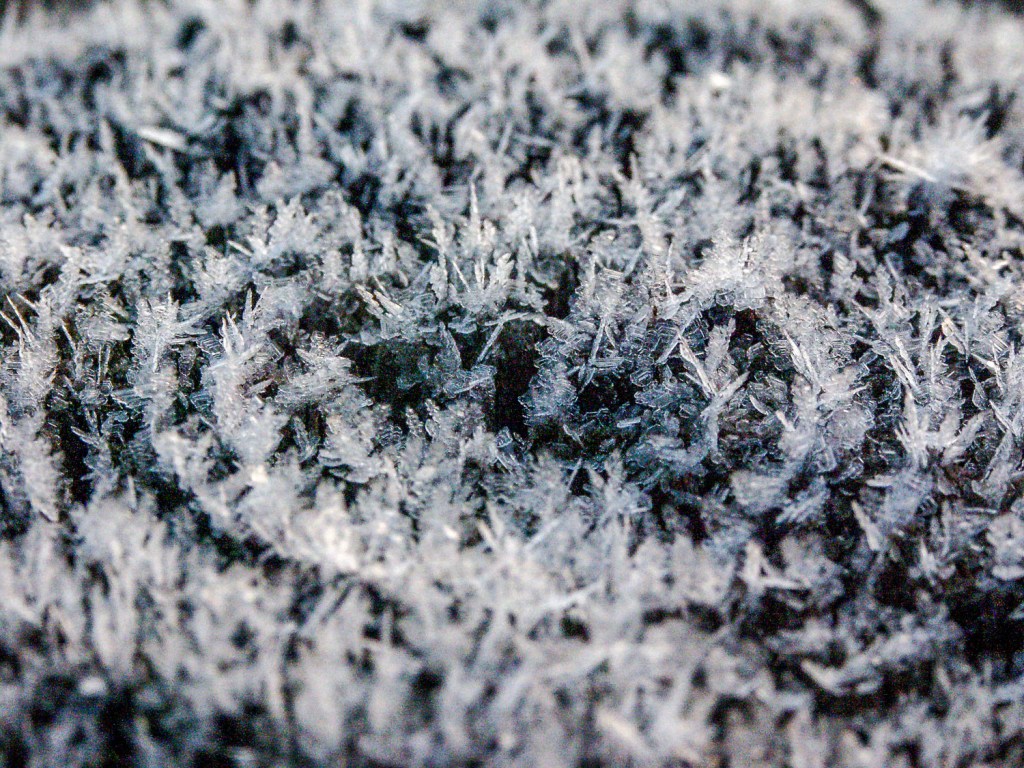
Ted Kooser, a wonderful poet from Nebraska who was also the National Poet Laurette, creates this beautiful “picture” of a frosty morning:
Hoarfrost
Two days of an icy prairie fog
and every blade of grass, and twig
and branch, and every stretch
of wire, barb, and staple,
is a knot or a thread in a lace
of the purest white. To walk
is like finding your way
through a wedding dress, the sky
inside it cold and satiny;
no past, no future, just the now
all breathless. Then a red bird,
like a pinprick, changes everything.

When you see frost, take a moment to really look at it and enjoy the moment because it usually doesn’t last long.
 Still Learning To See