
The Athenian Hall, built in the 1830s by Alexander Twilight, is a treasure of Vermont history.
Earlier in March Rob and I drove up to Brownington to visit the Athenian Hall built by schoolmaster Alexander Twilight as a dormitory in 1834. His house and several other buildings stand nearby, serving as the home of the Orleans County Historical Society.
Even on the cold, rainy day we had, the Athenian Hall defies imagining: four stories of huge granite blocks, a building made to last and to speak clearly of Twilight’s devotion to higher education. Some say he built it entirely by himself. Regardless, his life story is well worth treasuring and learning from.
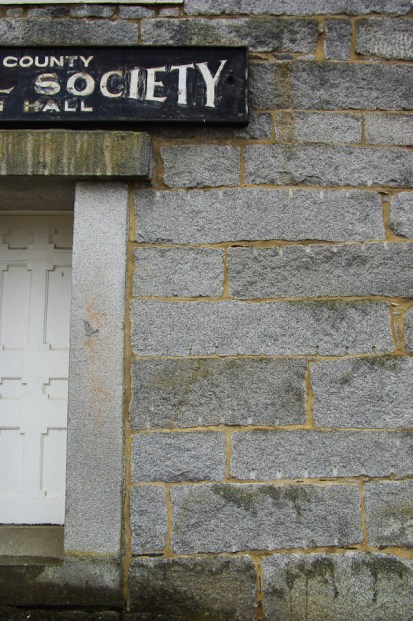
The granite was split in the quarry from bedrock by hand-drilling a series of holes several inches deep and then installing wedges to split the stone off along the fault lines. Moving them? Another story and a good one!
As I was looking at the photographs of the exterior of the Hall, I noticed the split stone was clearly marked with the handmade holes characteristic of the process used at the time. While much of Vermont is underlaid by granite bedrock, no one is certain where the stone came from that still stands today in this remarkable structure.
What a delight to connect back into time though both the granite and these photographs and think of the many important connections that exist between the natural and build worlds.
On a slight tangent, I look forward to seeing the stunning photographs of the Barre granite quarries made by Edward Burtynsky in May at Dartmouth’s Hood Art Museum. His is a very different and powerful way of seeing the built world.
 Still Learning To See
It’s taken me a few days to look up all the great references in this entry–the story of Twilight and the Athenian Hall is one I will send on to my brother who lives in Northampton MA and has spent much of his life researching the Underground Railroad. And the granite images by Burtynsky are literally breathtaking. This world is so full of miracle–thanks for continuing to remind me of them!
We seem to push that welcome task back and forth between each other!